Habuhiah
“God the liberal giver, God who gives abundantly”
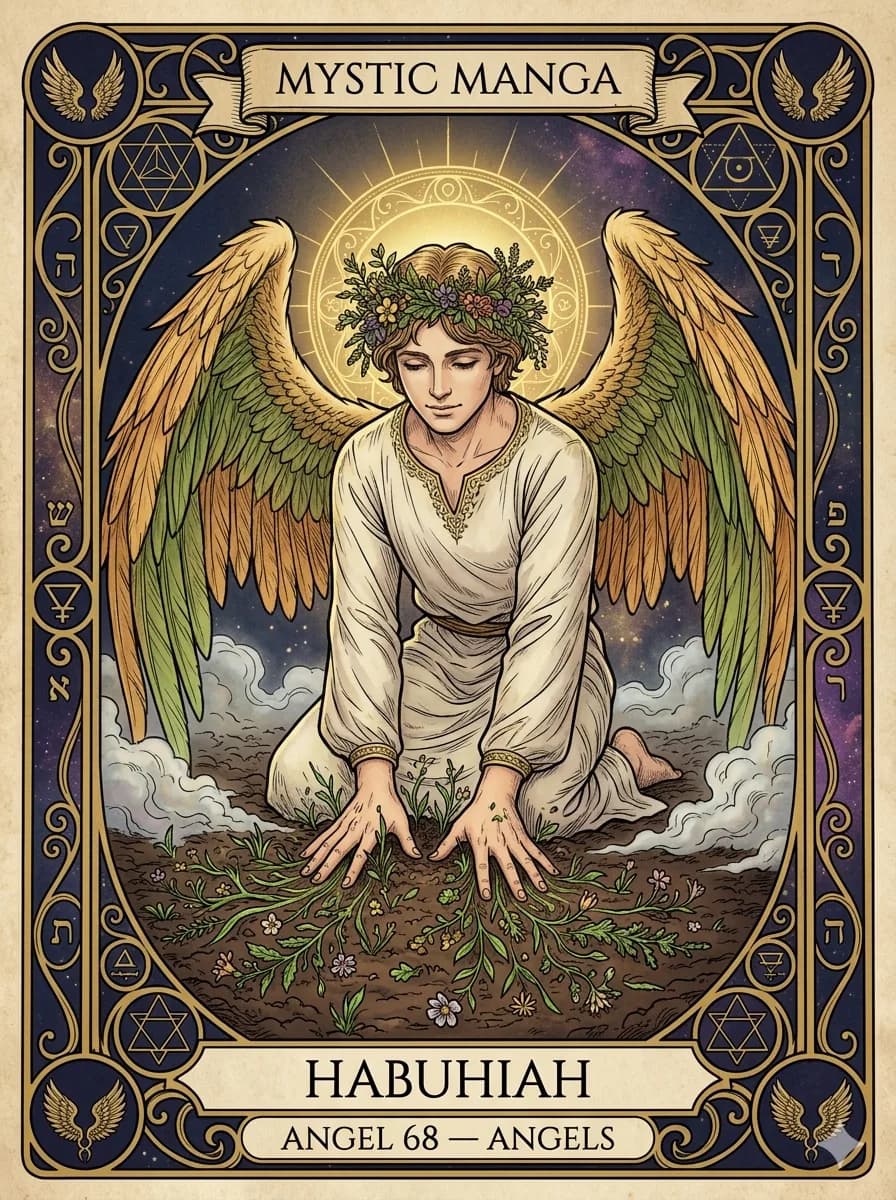
In short
Who is the angel Habuhiah?
Habuhiah (no. 68) belongs to the choir of Angels under the archangel Gabriel. Angel of healing and fertility, he presides over the health of body and earth, the fecundity of nature, and the generosity of natural cycles. He supports the healing of illness, the fertility of cultivated land, and reconciliation with biological rhythms. His breath is that of prodigal nature.
✡ Tradition and symbolism
Habuhiah is the sixty-eighth angel of the Shem HaMephorash, whose 72 divine names are extracted from verses 19 to 21 of Exodus chapter 14 through boustrophedon reading. He belongs to the choir of Angels, the final order of the celestial hierarchy, and works under the direction of the archangel Gabriel. His zodiacal domain covers 5° to 10° of Pisces, from February 24 to 28: the late-winter period when the first shoots seek light beneath still-cold earth, a perfect symbol of life returning despite the appearance of sterility.
The Christian Kabbalistic tradition attributes to him a therapeutic and agricultural vocation: Habuhiah is the angel of restored health, the nurturing earth, and the generosity of the living. Ambelain and Haziel describe him as a powerful aid in combating illness, particularly those linked to organic imbalances and troubles of fertility: human and vegetable alike. Healers, physicians, farmers, and gardeners place themselves under his patronage. He is also invoked to restore harmony between the body and its natural rhythms, so often disrupted by contemporary modes of living. His virtue as the 'liberal giver' is expressed in the profusion with which nature offers its resources to those who prove worthy of them.
Meditatively, Habuhiah reminds us that the body is not an obstacle to awakening but its primary ground. To care for the living, one's own organism, the plant on the balcony, the soil underfoot, is a form of prayer in action. To contemplate his name is to receive the fundamental generosity of the cosmos: life wants to perpetuate itself, grow, heal. Habuhiah is the seal of that will, the sign that the universe, at its core, is on the side of life.
📜 Traditional invocation verse
Tradition associates Habuhiah with Psalm 106:1, recited or meditated upon during invocation.
Prayer to the angel Habuhiah
Traditional prayer to Habuhiah, to recite or meditate on during its regency period (February 24 – 28):
"Habuhiah, generous dispenser, rekindle within me the natural force of healing and reconcile my body with the rhythms that sustain it."
How to pray to Habuhiah according to tradition
- Recite its invocation verse, Psalm 106:1.
- Meditate on its name, preferably during its regency period (February 24 – 28).
- State an intention related to its domains: healing, fertility, bodily health, natural cycles, generosity of life.
These practices belong to the spiritual and symbolic framework of the kabbalistic tradition.
Find your guardian angel
Your birth date is all it takes, instant answer.
Sunday Reading 🌙
One card, one intention, every Sunday morning.
Same choir: Angels (Gabriel)
Frequently asked questions
Who is the guardian angel Habuhiah (no. 68)?+
Habuhiah (no. 68) belongs to the choir of Angels under the archangel Gabriel. Angel of healing and fertility, he presides over the health of body and earth, the fecundity of nature, and the generosity of natural cycles. He supports the healing of illness, the fertility of cultivated land, and reconciliation with biological rhythms. His breath is that of prodigal nature.
When does the angel Habuhiah hold its regency?+
Habuhiah is angel 68 of the choir of Angels (prince Gabriel). It rules the period February 24 – 28 and the degrees 5° – 10° Pisces of the Pisces sign.
In which areas is the angel Habuhiah invoked?+
Habuhiah is invoked for: healing, fertility, bodily health, natural cycles, generosity of life.
Which prayer should be addressed to the angel Habuhiah?+
The kabbalistic tradition offers two prayer supports for Habuhiah: the recitation of its invocation psalm (Psalm 106:1) and meditation on its name. A traditional prayer to Habuhiah is provided on this page: it is best recited during its regency period (February 24 – 28).
Explore further
Pisces zodiac sign
Habuhiah rules 5° – 10° Pisces
🕚Mirror hour 22:22
Habuhiah is the guardian angel of 22:22
👼The 9 Choirs of Angels
Full hierarchy and archangels
😇Lenain and the 72 Angels Calendar
Who built the birth calendar, and why tables disagree
✡Kabbalah
Tree of Life and sephiroth
👼Angel Numbers
111, 222, 1111: their messages
🕯️Patron Saints
Invocations and intentions