Chakra 7/7 · 1000 petals
Crown Chakra
Sahasrāra
In short
What is the role of the crown chakra?
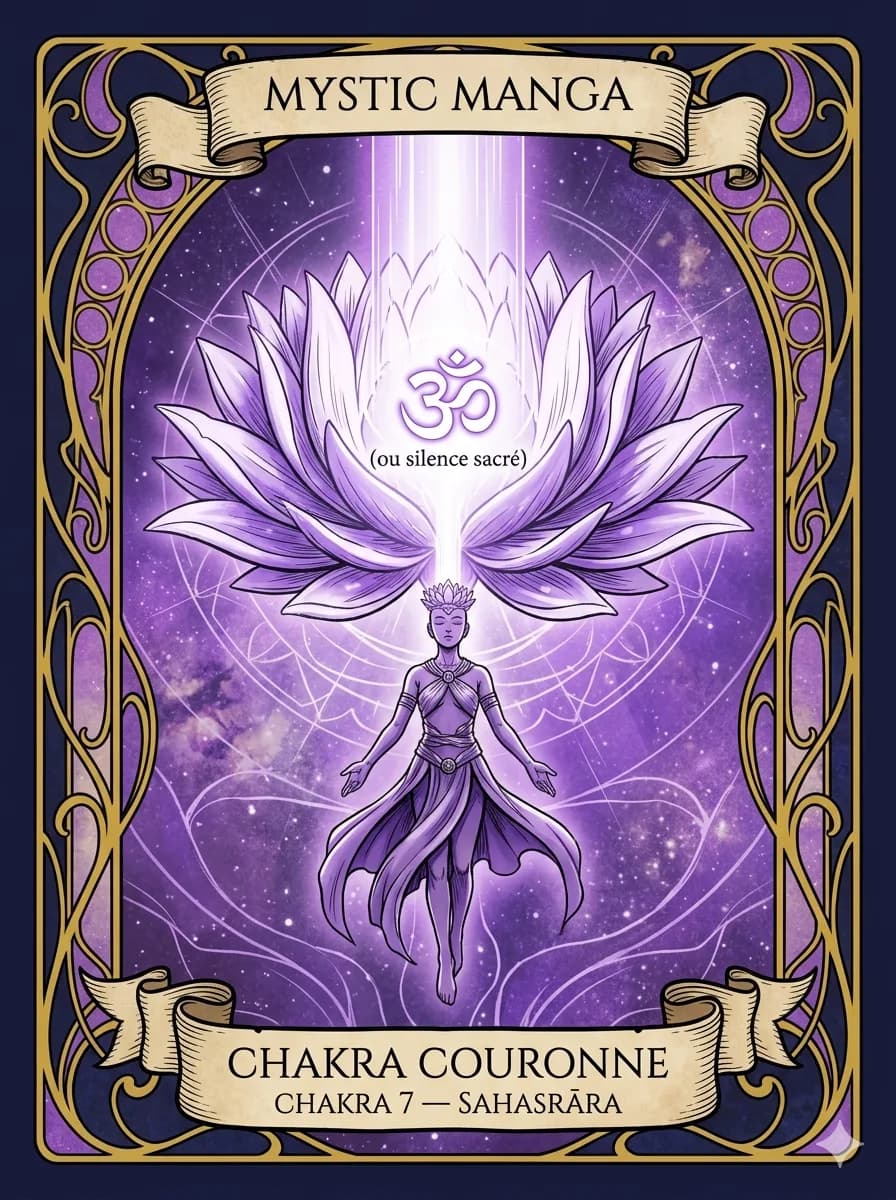
Sahasrāra, 'the thousand-petaled lotus' (sahasra: thousand, āra: spoke or petal), is the seventh and ultimate chakra in Tantric tradition. It is less an energetic center in the ordinary sense than a state of consciousness: the place of encounter between the individual ātman and the universal Brahman, between the drop and the ocean. Here, kuṇḍalinī śakti, having traversed all lower chakras, reaches its ultimate destination: union with Śiva, pure and unmanifested consciousness. Tradition describes this moment as samādhi: complete absorption in pure being, beyond time, space, and separation. The element is no longer an element in the classical sense: it is pure consciousness (cit), beyond even ether and light. The thousand-petaled lotus radiates all colors and all syllables of Sanskrit: symbol of the fullness of all potentialities. The deity is Paramaśiva in his absolute aspect, the indistinct union of all divine forms. Tradition emphasizes that Sahasrāra can be neither activated by technique alone, nor understood by the intellect. It reveals itself through grace (prasāda) and the dissolution of the practicing ego. It is the chakra of non-duality, of ineffable mystery, of fullness that needs nothing. In its resonance, all questions cease, not through ignorance, but through the disappearance of the one who questioned.
Color
Violet / Luminous White
Element
Pure Consciousness
Mantra
OM (ou silence sacré)
Location
Crown of the skull, fontanelle
🫀 In the body
Tradition associates Sahasrāra with the pineal gland, the cerebral cortex, and the totality of the nervous system in its function of receiving cosmic consciousness. Symbolically, it transcends all bodily localization. It is the portal, not an organ.
✨ When balanced
Tradition associates an open Sahasrāra with a living connection to the Whole, a sense of pure presence transcending the mind and its stories. The individual who touches this space lives in a deep peace that depends on no external condition, a total acceptance of what is, and a natural universal compassion. The boundary between self and world becomes permeable, not through confusion, but through recognition of fundamental unity.
🌑 Signs of blockage
Tradition symbolically associates a Sahasrāra closure with a feeling of radical separation: from God, from meaning, from others, from oneself. Nihilism, deep existential boredom, and doctrinal rigidity that fixes mystery into certainty are seen as signs of this unirrigated chakra. Tradition reminds us that the goal is not to 'force' opening, but to make oneself available to grace through practice, humility, and the relinquishment of certainties.
🧘 Balancing practices
Tradition recommends for Sahasrāra deep silent meditation (dhyāna and samādhi), the abandonment of all technique in pure silence, the practice of jnana yoga (yoga of direct knowledge), and bhakti yoga (yoga of devotion). The mantra OM or absolute silence are its traditional resonances. Clear quartz crystal, white selenite, and clear amethyst are traditionally associated with this chakra: stones of purity and transparency. Exposure to the natural light of the sky, the practice of nature contemplation, and essential oils of lotus, neroli, or frankincense (olibanum) support aspiration toward this center according to traditions.
Affirmation
"I am one with infinite consciousness: divine light unfolds through me."
Put it into practice
Two short quizzes to place where your energy actually sits today.
Frequently asked questions
What is the role of the Crown Chakra (Sahasrāra)?+
Sahasrāra, 'the thousand-petaled lotus' (sahasra: thousand, āra: spoke or petal), is the seventh and ultimate chakra in Tantric tradition. It is less an energetic center in the ordinary sense than a state of consciousness: the place of encounter between the individual ātman and the universal Brahman, between the drop and the ocean. Here, kuṇḍalinī śakti, having traversed all lower chakras, reaches its ultimate destination: union with Śiva, pure and unmanifested consciousness. Tradition describes this moment as samādhi: complete absorption in pure being, beyond time, space, and separation. The element is no longer an element in the classical sense: it is pure consciousness (cit), beyond even ether and light. The thousand-petaled lotus radiates all colors and all syllables of Sanskrit: symbol of the fullness of all potentialities. The deity is Paramaśiva in his absolute aspect, the indistinct union of all divine forms. Tradition emphasizes that Sahasrāra can be neither activated by technique alone, nor understood by the intellect. It reveals itself through grace (prasāda) and the dissolution of the practicing ego. It is the chakra of non-duality, of ineffable mystery, of fullness that needs nothing. In its resonance, all questions cease, not through ignorance, but through the disappearance of the one who questioned.
What are the signs of a blocked Crown Chakra?+
Tradition symbolically associates a Sahasrāra closure with a feeling of radical separation: from God, from meaning, from others, from oneself. Nihilism, deep existential boredom, and doctrinal rigidity that fixes mystery into certainty are seen as signs of this unirrigated chakra. Tradition reminds us that the goal is not to 'force' opening, but to make oneself available to grace through practice, humility, and the relinquishment of certainties.
How do you balance the Crown Chakra?+
Tradition recommends for Sahasrāra deep silent meditation (dhyāna and samādhi), the abandonment of all technique in pure silence, the practice of jnana yoga (yoga of direct knowledge), and bhakti yoga (yoga of devotion). The mantra OM or absolute silence are its traditional resonances. Clear quartz crystal, white selenite, and clear amethyst are traditionally associated with this chakra: stones of purity and transparency. Exposure to the natural light of the sky, the practice of nature contemplation, and essential oils of lotus, neroli, or frankincense (olibanum) support aspiration toward this center according to traditions.
Explore further
Root Chakra
Mūlādhāra
🧘Sacral Chakra
Svādhiṣṭhāna
🧘Solar Plexus Chakra
Maṇipūra
🏔️Tulpa: What She Actually Wrote
Visualization taken far enough to worry its author
🪷Samadhi
The 8 rungs, guided breath and self-inquiry
📖Grimoire
Crystals, herbs, mirror hours
🌙Lunar Calendar
Moon phases and rituals
📜Wisdom Codex
Deep esoteric articles