Chakra 1/7 · 4 petals
Root Chakra
Mūlādhāra
In short
What is the role of the root chakra?
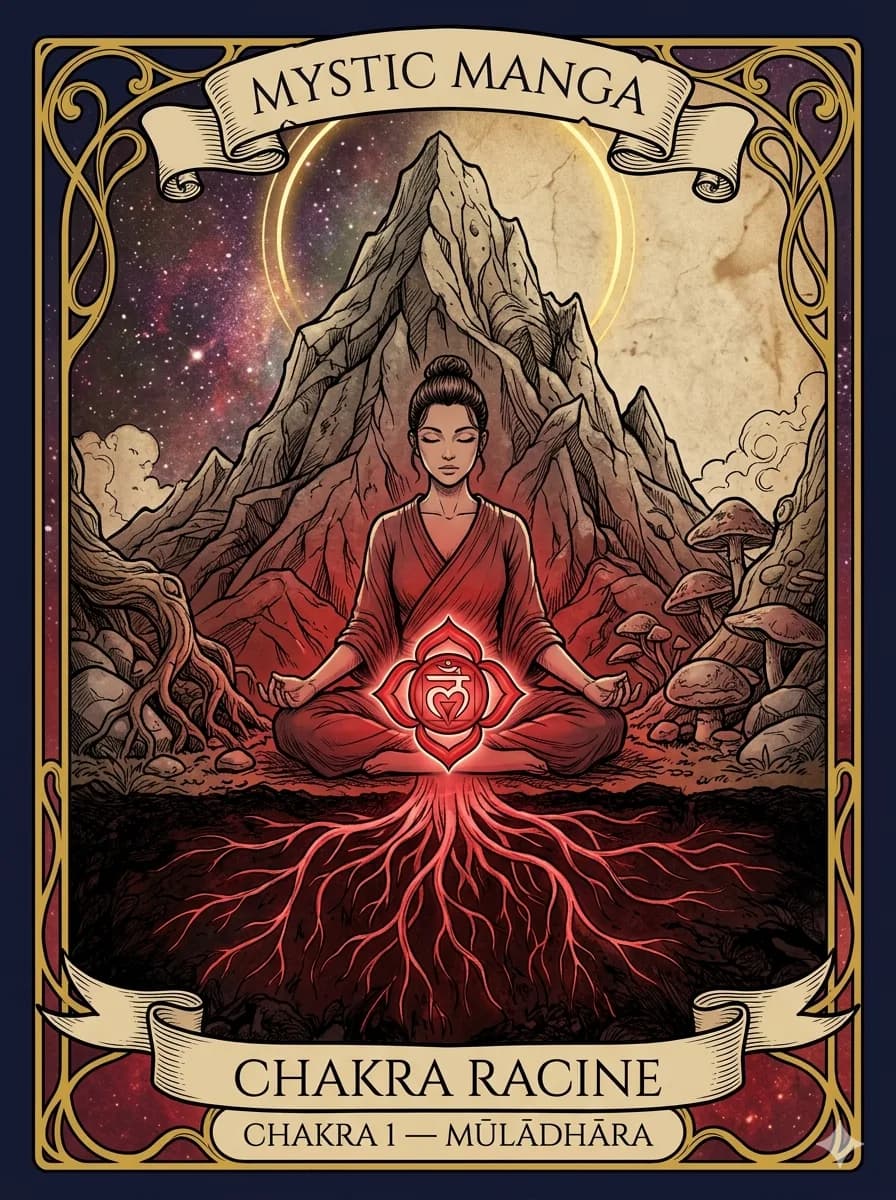
Mūlādhāra, whose Sanskrit name means 'root support' (mūla: root, ādhāra: foundation), is the first energetic center according to Tantric tradition. It constitutes the seat of earthly consciousness, the place where kuṇḍalinī śakti lies dormant, coiled three and a half times around the Svayambhu liṅgam, awaiting awakening. This chakra governs our most archaic relationship to existence: the right to be alive, fundamental security, the survival instinct. In yogic cosmology, it is associated with the Earth element (pṛthivī), dense and stable, and with the yellow square tattva. The energy of Mūlādhāra is that of groundedness, tribe, and ancestral memory. The tradition associates primal fear as its dominant emotion, not as pathology, but as a primitive alarm signal preserving life. Its yantra is a yellow square inscribed within a four-petaled crimson lotus, each petal bearing the syllables Vaṃ, Śaṃ, Ṣaṃ, and Saṃ. The resident deity is Gaṇeśa, lord of beginnings and obstacles, accompanied by Ḍākinī. Working with this chakra means establishing the foundations of a solid spiritual life: no ascension is possible without groundedness.
Color
Red
Element
Earth
Mantra
LAM
Location
Base of the spine, perineum
🫀 In the body
The yogic tradition associates Mūlādhāra with the adrenal glands, the skeletal system, the legs and feet. Symbolically, it governs fundamental vitality, the density of the physical body, and grounding in matter.
✨ When balanced
Tradition associates a balanced Mūlādhāra with a deep sense of inner security, belonging to the physical world, and trust in life. The grounded person manifests strong bodily presence, a healthy relationship to material resources, and the capacity to remain stable in adversity. They fully inhabit their body, breathe deeply, and feel legitimate in their existence. A flourishing sense of family and community, feet firmly on the ground: metaphorically and literally.
🌑 Signs of blockage
Tradition symbolically associates a Mūlādhāra imbalance with states of chronic anxiety, persistent feelings of insecurity, and fear of lack or abandonment. The individual may feel difficulty grounding, a tendency to live 'in their head', a troubled relationship to the body or money. Conversely, excess may manifest as rigidity, obsessive materialism, or resistance to change. Tradition reminds us that these signs are calls to inner work, not judgments.
🧘 Balancing practices
The Tantric and yogic tradition offers several paths to harmonize Mūlādhāra: grounding postures (Tadasana, Balasana, Malasana), earth pranayama (box breathing, nadi shodhana), earth meditation: walking barefoot, gardening, feeling stone. The bija mantra LAM, chanted or visualized, traditionally resonates with this center. Traditional crystal therapy associates it with red jasper, hematite, obsidian, and lava stone: dense stones carrying telluric energy. Deep sounds (Tibetan bowls tuned to D or C), the color red in the environment, and vetiver or patchouli aromatherapy complement these practices according to traditions.
Affirmation
"I am grounded, safe, and fully present in this body that is my home."
Put it into practice
Two short quizzes to place where your energy actually sits today.
Frequently asked questions
What is the role of the Root Chakra (Mūlādhāra)?+
Mūlādhāra, whose Sanskrit name means 'root support' (mūla: root, ādhāra: foundation), is the first energetic center according to Tantric tradition. It constitutes the seat of earthly consciousness, the place where kuṇḍalinī śakti lies dormant, coiled three and a half times around the Svayambhu liṅgam, awaiting awakening. This chakra governs our most archaic relationship to existence: the right to be alive, fundamental security, the survival instinct. In yogic cosmology, it is associated with the Earth element (pṛthivī), dense and stable, and with the yellow square tattva. The energy of Mūlādhāra is that of groundedness, tribe, and ancestral memory. The tradition associates primal fear as its dominant emotion, not as pathology, but as a primitive alarm signal preserving life. Its yantra is a yellow square inscribed within a four-petaled crimson lotus, each petal bearing the syllables Vaṃ, Śaṃ, Ṣaṃ, and Saṃ. The resident deity is Gaṇeśa, lord of beginnings and obstacles, accompanied by Ḍākinī. Working with this chakra means establishing the foundations of a solid spiritual life: no ascension is possible without groundedness.
What are the signs of a blocked Root Chakra?+
Tradition symbolically associates a Mūlādhāra imbalance with states of chronic anxiety, persistent feelings of insecurity, and fear of lack or abandonment. The individual may feel difficulty grounding, a tendency to live 'in their head', a troubled relationship to the body or money. Conversely, excess may manifest as rigidity, obsessive materialism, or resistance to change. Tradition reminds us that these signs are calls to inner work, not judgments.
How do you balance the Root Chakra?+
The Tantric and yogic tradition offers several paths to harmonize Mūlādhāra: grounding postures (Tadasana, Balasana, Malasana), earth pranayama (box breathing, nadi shodhana), earth meditation: walking barefoot, gardening, feeling stone. The bija mantra LAM, chanted or visualized, traditionally resonates with this center. Traditional crystal therapy associates it with red jasper, hematite, obsidian, and lava stone: dense stones carrying telluric energy. Deep sounds (Tibetan bowls tuned to D or C), the color red in the environment, and vetiver or patchouli aromatherapy complement these practices according to traditions.
Explore further
Sacral Chakra
Svādhiṣṭhāna
🧘Solar Plexus Chakra
Maṇipūra
🧘Heart Chakra
Anāhata
🏔️Tulpa: What She Actually Wrote
Visualization taken far enough to worry its author
🪷Samadhi
The 8 rungs, guided breath and self-inquiry
📖Grimoire
Crystals, herbs, mirror hours
🌙Lunar Calendar
Moon phases and rituals
📜Wisdom Codex
Deep esoteric articles