Chakra 2/7 · 6 petals
Sacral Chakra
Svādhiṣṭhāna
In short
What is the role of the sacral chakra?
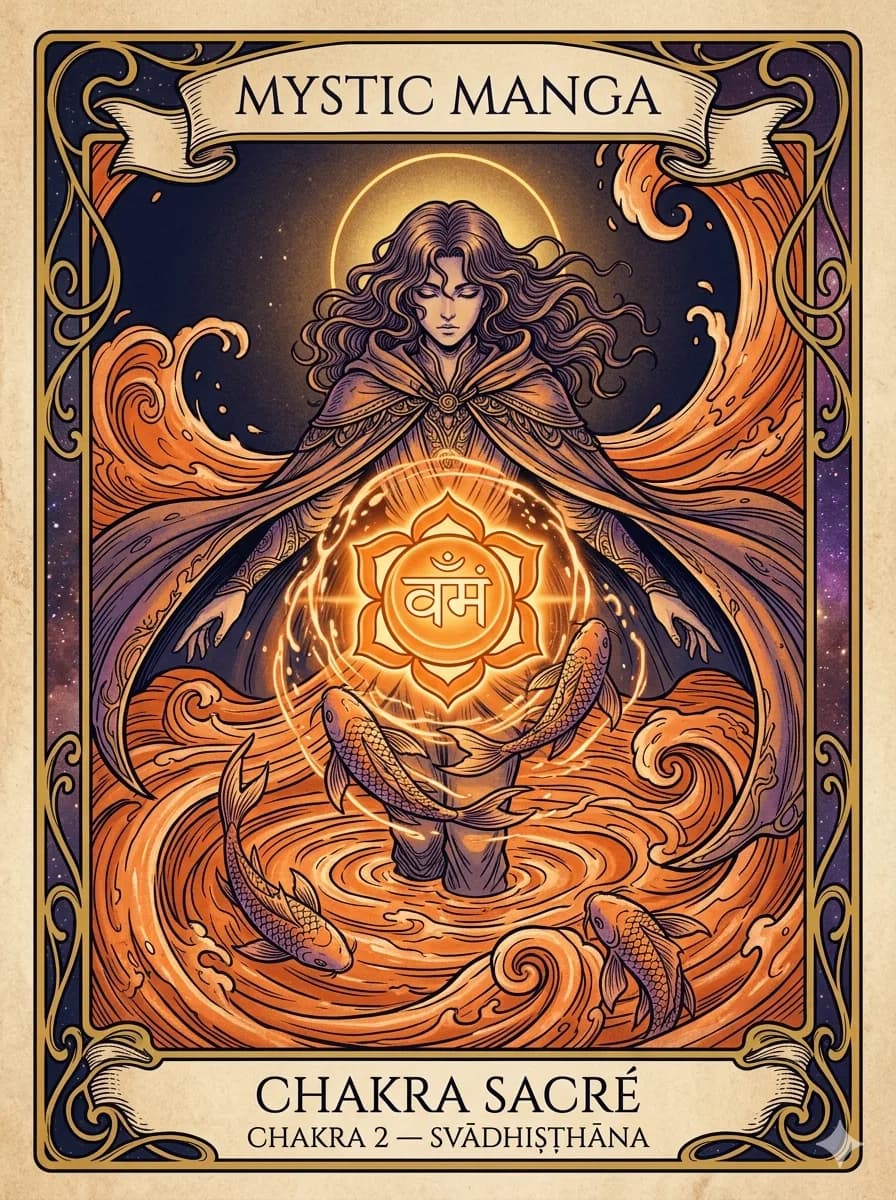
Svādhiṣṭhāna, meaning 'its own abode' or 'dwelling of the self' (sva: self, adhiṣṭhāna: dwelling), is the second chakra in Tantric tradition. It is the center of movement, flow, and sacred pleasure. Associated with the Water element (āpas), its energy is fluid, changing, creative: like the moon and tides. Here resides the creative life force (śakti) in its most immediate form: desire, sensuality, imagination, aesthetic pleasure. Tantric tradition venerates this chakra as the seat of pure emotion, prior to mental constructs. The six-petaled lotus of vermilion color bears the syllables Baṃ, Bhaṃ, Maṃ, Yaṃ, Raṃ, and Laṃ. Varuṇa, god of waters and cosmic truth, is the associated deity, with Rākinī as śakti. The symbolic animal is the crocodile (makara), master of unconscious depths. Tradition teaches that imbalance in this center often arises from guilt around pleasure or repression of creative desire. Its awakening releases organic joy and the capacity to flow with change rather than resist it. This is the chakra of intimacy, with oneself, with another, with the mystery of the living.
Color
Orange
Element
Water
Mantra
VAM
Location
Lower abdomen, approximately two fingers below the navel
🫀 In the body
Tradition associates Svādhiṣṭhāna with the reproductive organs, kidneys, bladder, and lower back. Symbolically, it governs bodily fluids, germinative creativity, and sexual vitality understood as a sacred creative force.
✨ When balanced
Tradition associates a harmonious Svādhiṣṭhāna with fluid and joyful creativity, and the ability to fully feel emotions without being overwhelmed by them. The individual balanced in this center enjoys life with lightness, welcomes pleasure without guilt, and adapts to change as water takes the shape of its container. They maintain relationships marked by authenticity and tenderness, and their creativity expresses naturally across all domains.
🌑 Signs of blockage
Tradition symbolically associates a Svādhiṣṭhāna imbalance with creative aridity, difficulty feeling or expressing emotions, and blocks in the sphere of pleasure or sensuality. Guilt around desire, emotional rigidity, or conversely, addiction to sensations can be signals. Tradition invites us to observe these patterns as invitations to rediscover the natural current of vital flow.
🧘 Balancing practices
Practices traditionally associated with Svādhiṣṭhāna include fluid body movements (dance, water yoga, Shakti yoga), hip-opening postures (Baddha Koṇāsana, Gomukhasana), and water meditation: observing a flowing stream, taking a sacred bath. The mantra VAM, chanted softly, traditionally resonates with this center. Carnelian, moonstone, and orange jasper are traditionally associated with this chakra. Baths with essential oils of ylang-ylang, sandalwood, or sweet orange, as well as the practice of creative writing or free drawing, complement these paths of harmonization.
Affirmation
"I allow myself to feel, to create, and to delight in the living beauty that flows within me."
Put it into practice
Two short quizzes to place where your energy actually sits today.
Frequently asked questions
What is the role of the Sacral Chakra (Svādhiṣṭhāna)?+
Svādhiṣṭhāna, meaning 'its own abode' or 'dwelling of the self' (sva: self, adhiṣṭhāna: dwelling), is the second chakra in Tantric tradition. It is the center of movement, flow, and sacred pleasure. Associated with the Water element (āpas), its energy is fluid, changing, creative: like the moon and tides. Here resides the creative life force (śakti) in its most immediate form: desire, sensuality, imagination, aesthetic pleasure. Tantric tradition venerates this chakra as the seat of pure emotion, prior to mental constructs. The six-petaled lotus of vermilion color bears the syllables Baṃ, Bhaṃ, Maṃ, Yaṃ, Raṃ, and Laṃ. Varuṇa, god of waters and cosmic truth, is the associated deity, with Rākinī as śakti. The symbolic animal is the crocodile (makara), master of unconscious depths. Tradition teaches that imbalance in this center often arises from guilt around pleasure or repression of creative desire. Its awakening releases organic joy and the capacity to flow with change rather than resist it. This is the chakra of intimacy, with oneself, with another, with the mystery of the living.
What are the signs of a blocked Sacral Chakra?+
Tradition symbolically associates a Svādhiṣṭhāna imbalance with creative aridity, difficulty feeling or expressing emotions, and blocks in the sphere of pleasure or sensuality. Guilt around desire, emotional rigidity, or conversely, addiction to sensations can be signals. Tradition invites us to observe these patterns as invitations to rediscover the natural current of vital flow.
How do you balance the Sacral Chakra?+
Practices traditionally associated with Svādhiṣṭhāna include fluid body movements (dance, water yoga, Shakti yoga), hip-opening postures (Baddha Koṇāsana, Gomukhasana), and water meditation: observing a flowing stream, taking a sacred bath. The mantra VAM, chanted softly, traditionally resonates with this center. Carnelian, moonstone, and orange jasper are traditionally associated with this chakra. Baths with essential oils of ylang-ylang, sandalwood, or sweet orange, as well as the practice of creative writing or free drawing, complement these paths of harmonization.
Explore further
Solar Plexus Chakra
Maṇipūra
🧘Heart Chakra
Anāhata
🧘Throat Chakra
Viśuddha
🏔️Tulpa: What She Actually Wrote
Visualization taken far enough to worry its author
🪷Samadhi
The 8 rungs, guided breath and self-inquiry
📖Grimoire
Crystals, herbs, mirror hours
🌙Lunar Calendar
Moon phases and rituals
📜Wisdom Codex
Deep esoteric articles