Chakra 6/7 · 2 petals
Third Eye Chakra
Ājñā
In short
What is the role of the third eye chakra?
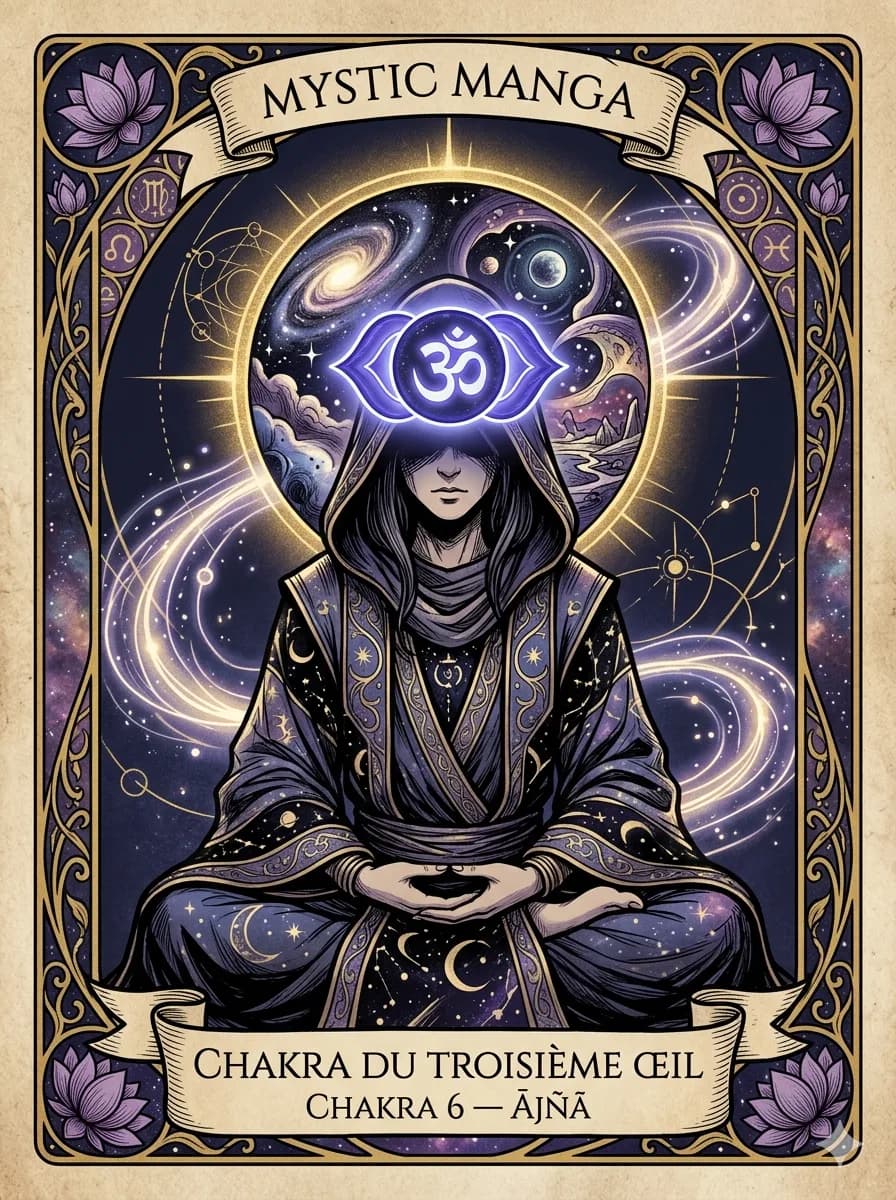
Ājñā, 'command' or 'authority' (ājñā: order, command), is the sixth chakra, seat of transcendent intuition and direct vision. Here, the two polar nāḍīs, Iḍā (moon, feminine) and Piṅgalā (sun, masculine), converge and dissolve, giving way to the sole median channel (suṣumnā). It is the convergence point of opposites, the place where the knower and the known tend toward unity. The associated element is Light (āloka or subtle tejas), no longer the gross elements of the manifested world, but the very substance of perception. The lotus with only two great petals (sometimes interpreted as two wings, symbols of Iḍā and Piṅgalā) bears the syllables Haṃ and Kṣaṃ. The deity is Paramaśiva in his subtle aspect, with Hākinī as the six-faced śakti, symbolizing the six siddhi (powers) of awakened consciousness. Tradition teaches that Ājñā is Śiva's third eye: the eye that sees beyond time and forms, perceiving reality as it is. Its awakening is associated with the development of intuition, clairvoyance, discernment (viveka), and the wisdom that distinguishes the real from the illusory. This chakra is the center of the inner guru: the voice of deep consciousness that guides without error.
Color
Indigo
Element
Light
Mantra
OM
Location
Between the two eyes, at the center of the forehead
🫀 In the body
Tradition associates Ājñā with the pituitary gland (hypophysis), the eyes, and the brain in its synthesizing function. Symbolically, it governs subtle perception, the faculty of inner vision, and the coordination of all higher faculties of consciousness.
✨ When balanced
Tradition associates an open Ājñā with reliable and developed intuition, a capacity for subtle discernment between the essential and the incidental. The individual awakened in this center perceives invisible patterns, reads situations in depth, and accesses a wisdom transcending ordinary logic. They live in alignment between inner visions and outer actions, and their creativity is nourished by inspiration that seems to come from beyond the ordinary mind.
🌑 Signs of blockage
Tradition symbolically associates an Ājñā imbalance with a tendency toward hyperrationalism that crushes intuition, or conversely toward credulity and confusion between imagination and real perception. Rejection of the subtle world and spiritual dogmatism are both forms of excess that tradition recognizes as closures of this center. Mental rigidity and difficulty perceiving nuances signal an invitation to cultivate inner silence.
🧘 Balancing practices
Tradition recommends for Ājñā Trataka meditation (concentration on a point or flame), yoga nidra, guided visualizations of inner light, and the practice of deep silence (extended mauna). The mantra OM (or AUM), one of the most sacred, resonates at the heart of this center. Amethyst, purple fluorite, azurite, and labradorite are traditionally associated with this chakra. Sensory fasting, regular lucid dreaming practice, and essential oils of fine lavender or clary sage support the awakening of this center according to traditions.
Affirmation
"I trust my inner vision. I perceive truth beyond appearances."
Put it into practice
Two short quizzes to place where your energy actually sits today.
Frequently asked questions
What is the role of the Third Eye Chakra (Ājñā)?+
Ājñā, 'command' or 'authority' (ājñā: order, command), is the sixth chakra, seat of transcendent intuition and direct vision. Here, the two polar nāḍīs, Iḍā (moon, feminine) and Piṅgalā (sun, masculine), converge and dissolve, giving way to the sole median channel (suṣumnā). It is the convergence point of opposites, the place where the knower and the known tend toward unity. The associated element is Light (āloka or subtle tejas), no longer the gross elements of the manifested world, but the very substance of perception. The lotus with only two great petals (sometimes interpreted as two wings, symbols of Iḍā and Piṅgalā) bears the syllables Haṃ and Kṣaṃ. The deity is Paramaśiva in his subtle aspect, with Hākinī as the six-faced śakti, symbolizing the six siddhi (powers) of awakened consciousness. Tradition teaches that Ājñā is Śiva's third eye: the eye that sees beyond time and forms, perceiving reality as it is. Its awakening is associated with the development of intuition, clairvoyance, discernment (viveka), and the wisdom that distinguishes the real from the illusory. This chakra is the center of the inner guru: the voice of deep consciousness that guides without error.
What are the signs of a blocked Third Eye Chakra?+
Tradition symbolically associates an Ājñā imbalance with a tendency toward hyperrationalism that crushes intuition, or conversely toward credulity and confusion between imagination and real perception. Rejection of the subtle world and spiritual dogmatism are both forms of excess that tradition recognizes as closures of this center. Mental rigidity and difficulty perceiving nuances signal an invitation to cultivate inner silence.
How do you balance the Third Eye Chakra?+
Tradition recommends for Ājñā Trataka meditation (concentration on a point or flame), yoga nidra, guided visualizations of inner light, and the practice of deep silence (extended mauna). The mantra OM (or AUM), one of the most sacred, resonates at the heart of this center. Amethyst, purple fluorite, azurite, and labradorite are traditionally associated with this chakra. Sensory fasting, regular lucid dreaming practice, and essential oils of fine lavender or clary sage support the awakening of this center according to traditions.
Explore further
Crown Chakra
Sahasrāra
🧘Root Chakra
Mūlādhāra
🧘Sacral Chakra
Svādhiṣṭhāna
🏔️Tulpa: What She Actually Wrote
Visualization taken far enough to worry its author
🪷Samadhi
The 8 rungs, guided breath and self-inquiry
📖Grimoire
Crystals, herbs, mirror hours
🌙Lunar Calendar
Moon phases and rituals
📜Wisdom Codex
Deep esoteric articles