Chakra 4/7 · 12 petals
Heart Chakra
Anāhata
In short
What is the role of the heart chakra?
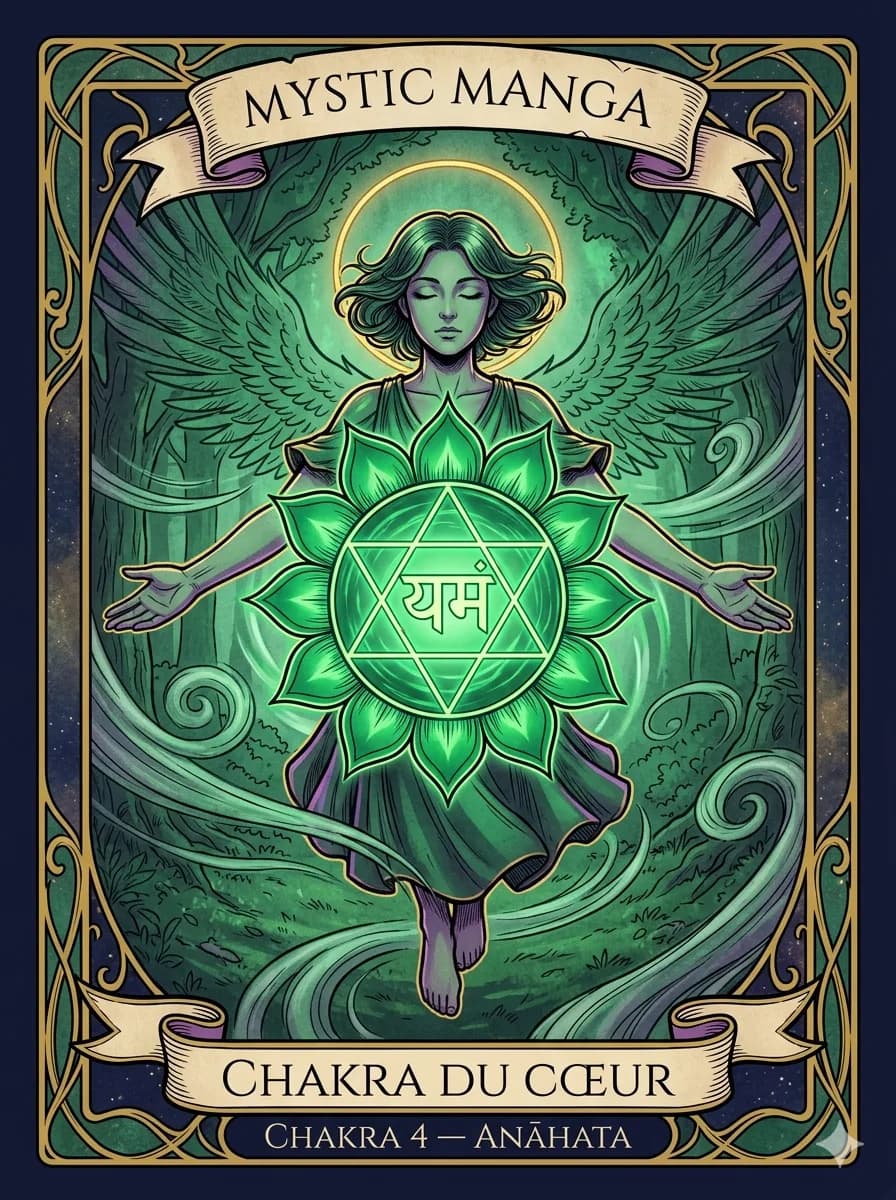
Anāhata, 'the unstruck sound' or 'the indestructible' (ana-āhata: not-struck, designating the primordial sound of the cosmos not produced by a collision), is the fourth chakra, the pivot point of the entire system. It is the great crossroads: where matter meets spirit, where the personal rejoins the universal, where fear dissolves into love. The Air element (vāyu), invisible and omnipresent, governs here. Like breath, the love associated with Anāhata is neither possessive nor conditional: it is the quality of consciousness that recognizes unity beneath diversity. The twelve-petaled lotus of luminous green, sometimes tinged with rose, bears the syllables Kaṃ, Khaṃ, Gaṃ, Ghaṃ, Ṅaṃ, Caṃ, Chaṃ, Jaṃ, Jhaṃ, Ñaṃ, Ṭaṃ, and Ṭhaṃ. Īśa (Śiva in his aspect of grace) is the associated deity, with Kākinī as śakti. Within the lotus is a yantra of two interlaced triangles: symbol of the union of polarities. Tradition teaches that Anāhata is the seat of the ātman, the individual divine spark, and that its resonance is compassion, gratitude, and forgiveness. Here the practitioner discovers that love is not a feeling but a state of being.
Color
Emerald Green
Element
Air
Mantra
YAM
Location
Center of the chest, at the level of the heart
🫀 In the body
Tradition associates Anāhata with the heart, lungs, thymus, and arms. Symbolically, it governs circulation, of blood, breath, and love, and represents the bridge between the lower centers (body, instinct) and the upper centers (spirit, consciousness).
✨ When balanced
Tradition associates an open Anāhata with the ability to love unconditionally, oneself and others, and to give and receive with equal ease. The individual radiates natural warmth, cultivates compassion without losing themselves, and lives grief and loss with grace. They feel connected to the living, touched by beauty, inhabited by a silent gratitude. Their relationships are authentic, founded on freedom rather than dependency.
🌑 Signs of blockage
Tradition symbolically associates an Anāhata imbalance with a closing of the heart after wounding, difficulty trusting, and a feeling of isolation or unworthiness of love. In excess, it may manifest as emotional dependency, an inability to protect oneself, or a generosity that exhausts itself. These patterns are seen by tradition as calls to self-love as the primary practice.
🧘 Balancing practices
Tradition recommends for Anāhata heart-opening postures (Ustrasana, Bhujangasana, Anahatasana), compassion pranayama (anāhata breathing: inhaling love, exhaling grace), and the practice of mettā (loving-kindness) from Buddhism. The mantra YAM, chanted with tenderness, resonates with this center. Rose quartz, rhodonite, green aventurine, and emerald are traditionally associated with this chakra. Writing a letter of forgiveness, practicing daily gratitude, and essential oils of rose or bergamot complement these practices.
Affirmation
"My heart is open. I give and receive love freely, and I recognize myself as worthy of tenderness."
Put it into practice
Two short quizzes to place where your energy actually sits today.
Frequently asked questions
What is the role of the Heart Chakra (Anāhata)?+
Anāhata, 'the unstruck sound' or 'the indestructible' (ana-āhata: not-struck, designating the primordial sound of the cosmos not produced by a collision), is the fourth chakra, the pivot point of the entire system. It is the great crossroads: where matter meets spirit, where the personal rejoins the universal, where fear dissolves into love. The Air element (vāyu), invisible and omnipresent, governs here. Like breath, the love associated with Anāhata is neither possessive nor conditional: it is the quality of consciousness that recognizes unity beneath diversity. The twelve-petaled lotus of luminous green, sometimes tinged with rose, bears the syllables Kaṃ, Khaṃ, Gaṃ, Ghaṃ, Ṅaṃ, Caṃ, Chaṃ, Jaṃ, Jhaṃ, Ñaṃ, Ṭaṃ, and Ṭhaṃ. Īśa (Śiva in his aspect of grace) is the associated deity, with Kākinī as śakti. Within the lotus is a yantra of two interlaced triangles: symbol of the union of polarities. Tradition teaches that Anāhata is the seat of the ātman, the individual divine spark, and that its resonance is compassion, gratitude, and forgiveness. Here the practitioner discovers that love is not a feeling but a state of being.
What are the signs of a blocked Heart Chakra?+
Tradition symbolically associates an Anāhata imbalance with a closing of the heart after wounding, difficulty trusting, and a feeling of isolation or unworthiness of love. In excess, it may manifest as emotional dependency, an inability to protect oneself, or a generosity that exhausts itself. These patterns are seen by tradition as calls to self-love as the primary practice.
How do you balance the Heart Chakra?+
Tradition recommends for Anāhata heart-opening postures (Ustrasana, Bhujangasana, Anahatasana), compassion pranayama (anāhata breathing: inhaling love, exhaling grace), and the practice of mettā (loving-kindness) from Buddhism. The mantra YAM, chanted with tenderness, resonates with this center. Rose quartz, rhodonite, green aventurine, and emerald are traditionally associated with this chakra. Writing a letter of forgiveness, practicing daily gratitude, and essential oils of rose or bergamot complement these practices.
Explore further
Throat Chakra
Viśuddha
🧘Third Eye Chakra
Ājñā
🧘Crown Chakra
Sahasrāra
🏔️Tulpa: What She Actually Wrote
Visualization taken far enough to worry its author
🪷Samadhi
The 8 rungs, guided breath and self-inquiry
📖Grimoire
Crystals, herbs, mirror hours
🌙Lunar Calendar
Moon phases and rituals
📜Wisdom Codex
Deep esoteric articles