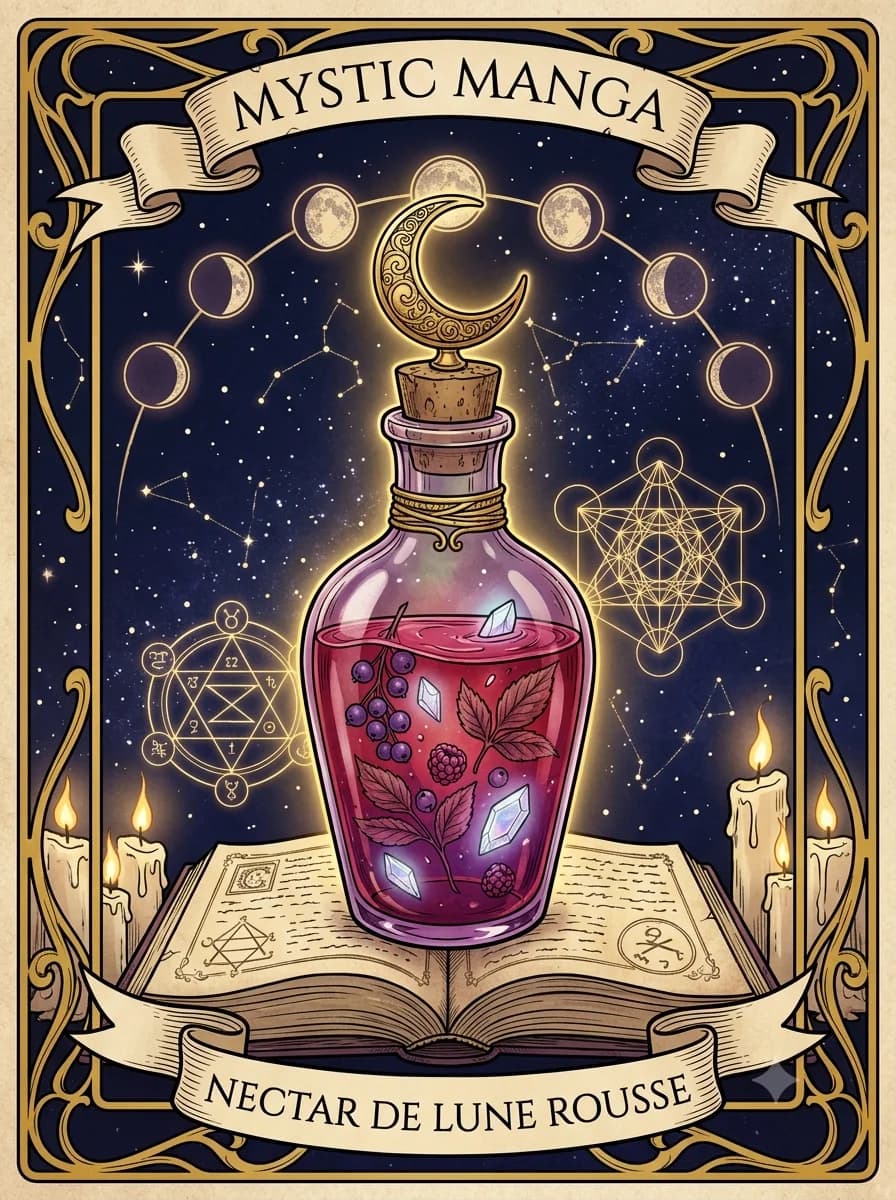
Red Moon Nectar: Feminine Cycle & PMS Balance Potion
Red Moon Nectar: feminine cycle potion with chasteberry (vitex), magnesium, vitamin B6, calcium. Premenstrual syndrome, mood swings, breast tenderness. Clinical studies, contraindications.
In short
What is Red Moon Nectar: Feminine Cycle & PMS Balance Potion and what does it do?
Red Moon Nectar: feminine cycle potion with chasteberry (vitex), magnesium, vitamin B6, calcium. Premenstrual syndrome, mood swings, breast tenderness. Clinical studies, contraindications.
This potion accompanies the feminine cycle through its premenstrual phase, irritability, breast tenderness, fatigue, mood swings, not to fight the cyclical body, but to support it with nutrients whose effect on these symptoms is among the best documented in women's herbal medicine.
This potion accompanies the feminine cycle through its premenstrual phase, irritability, breast tenderness, fatigue, mood swings, not to fight the cyclical body, but to support it with nutrients whose effect on these symptoms is among the best documented in women's herbal medicine.
⚠️ Medical disclaimer
This potion supports menstrual cycle comfort; it does not replace gynecological follow-up. If premenstrual symptoms are severe enough to significantly disrupt work, relationships, or mood (premenstrual dysphoric disorder), consult a physician. This clinical picture requires specific, sometimes medication-based, care. Always consult your doctor or gynecologist before taking chasteberry or evening primrose oil in case of ongoing hormonal treatment, desire for pregnancy, or history of hormone-dependent cancer.
🌿 Ingredients
🔥 Preparation
- 1.Starting on cycle day 14 (or at the first premenstrual signs if the cycle is irregular), steep the raspberry leaves for 10 minutes in 250 ml of simmering water.
- 2.Strain and let cool slightly.
- 3.Take alongside, with a little water: chasteberry in the morning on an empty stomach (recommended timing for good absorption), magnesium and vitamin B6 in the evening.
- 4.Calcium is taken in two doses, morning and evening, apart from magnesium (the two minerals compete for absorption if taken together).
- 5.Evening primrose oil is taken with a meal, if used.
- 6.Drink the raspberry leaf infusion slowly, placing a warm water bottle on the lower abdomen if tension is already present: heat relaxes the uterine muscle and enhances the felt relief.
- 7.Note the date symptoms start in a notebook or cycle-tracking app. This allows you to objectively track improvement over 2-3 cycles, as most effects are not immediate.
📋 Dosage
Cyclical intake during the luteal phase (from ovulation to menstruation), resumed each cycle. Chasteberry needs 2 to 3 cycles for full effect on prolactin regulation: don't judge efficacy after a single month. Magnesium, B6, and calcium can start on cycle day 14 and stop on the first day of menstruation. Minimum evaluation course: 3 consecutive cycles.
✨ Benefits
- ◆Reduced premenstrual irritability and mood swings
- ◆Decreased breast tenderness and sensitivity
- ◆Less water retention and bloating during the luteal phase
- ◆Reduced cramps and pelvic pain
- ◆Better perceived cycle regularity over several months (chasteberry)
- ◆A sense of accompanying rather than fighting one's own cyclical body
⚗️ Science
Randomized, double-blind, placebo-controlled trial (N=170, 3 cycles): chasteberry extract significantly reduces premenstrual syndrome symptoms (irritability, mood changes, anger, headache, breast tenderness, bloating) compared to placebo.
Schellenberg R: Treatment for the premenstrual syndrome with Vitex agnus-castus fruit extract: prospective, randomised, placebo-controlled study, BMJ (2001)
Systematic literature review: vitamin B6 (up to 100 mg/day) is associated with a reduction in overall PMS symptoms, particularly depressive symptoms, compared to placebo across several trials.
Wyatt KM, Dimmock PW, Jones PW, Shaughn O'Brien PM. Efficacy of vitamin B-6 in the treatment of premenstrual syndrome: systematic review, BMJ (1999)
Randomized placebo-controlled trial (mid-cycle, premenstrual symptoms): magnesium supplementation significantly improves premenstrual mood changes compared to placebo.
Facchinetti F, Borella P, Sances G, et al.. Oral magnesium successfully relieves premenstrual mood changes, Obstetrics & Gynecology (1991)
Multicenter randomized trial (N=497, 3 cycles): calcium carbonate (1200 mg/day) significantly reduces overall premenstrual symptoms, mood, water retention, pain, food cravings, compared to placebo.
Thys-Jacobs S, Starkey P, Bernstein D, Tian J. Calcium carbonate and the premenstrual syndrome: effects on premenstrual and menstrual symptoms, American Journal of Obstetrics and Gynecology (1998)
Systematic review of controlled trials on evening primrose oil in PMS: the most methodologically rigorous studies show no significant benefit over placebo, unlike older, lower-quality studies: the evidence is judged weak.
Budeiri D, Li Wan Po A, Dornan JC. Is evening primrose oil of value in the treatment of premenstrual syndrome?, Controlled Clinical Trials (1996)
⚠️ Contraindications
- •Pregnancy and breastfeeding (chasteberry strictly contraindicated: effect on prolactin and estrogens)
- •Hormone-dependent cancer (breast, endometrium, ovary): chasteberry and evening primrose oil not recommended without oncology advice
- •Hormonal treatment (contraceptive pill, HRT, fertility treatment): chasteberry may interfere, medical advice essential
- •Epileptic disorder (evening primrose oil may lower the seizure threshold at high doses)
- •Severe renal insufficiency (calcium and magnesium to be adjusted with a nephrologist)
- •History of recurrent calcium kidney stones (calcium to be discussed with a physician)
🔄 Interactions
- •Hormonal contraceptives and fertility treatments: chasteberry may reduce their efficacy or interact with the hormonal axis
- •Dopamine antagonists (certain antipsychotics): chasteberry has dopaminergic activity, possible interaction
- •Anticoagulants: high-dose evening primrose oil may slightly increase bleeding risk
- •Levothyroxine and bisphosphonates: calcium reduces their absorption, space out by 2 to 4 hours
- •Diuretics: monitor magnesium and calcium intake in cases of long-term diuretic treatment
🔮 Mystic Correspondence
Crystal
Moonstone as the primary stone (feminine cycles, intuition, hormonal fluidity); Garnet in support (vitality, grounding during menstruation)
Tarot
The Moon (XVIII): the tides, the cycles, the irrational rising and falling without needing to be judged, a card of a body following its own rhythm
Planet
Moon, particularly during the waning phase and during the red moon (the last new moon before the spring equinox, a traditional symbol of cycle renewal)
Ritual
During the luteal phase, keep a cycle journal noting mood, energy, and physical symptoms each day: beyond the mystical aspect, this practice concretely helps distinguish true PMS from premenstrual dysphoric disorder (PMDD), which would require specialized medical advice. Warm Epsom salt bath (rich in transdermal magnesium) in case of cramps
Other Elixirs
Explore further
Sap of Renewal: Liver Support Potion
Sap of Renewal: liver support potion with milk thistle (silymarin), NAC, artichoke. What science actually validates about the liver, without the "detox" myth. Studies, complete contraindications.
📚Mercury's Ink Junior: Exam Focus Potion
Mercury's Ink Junior: focus potion for exams and revision, citicoline, gently dosed bacopa monnieri, L-tyrosine. No stimulant overload. Clinical studies, contraindications.
🔥Endurance & Sacred Vigor: Warrior's Potion
Male sexual endurance potion: black maca, tribulus, red Korean ginseng, L-citrulline. Precise doses, PubMed-sourced studies (Cormio 2011, Gonzales 2002, Cochrane 2021), complete contraindications.
📖Grimoire
Crystals, herbs, mirror hours
🕯️Patron Saints
Invocations and intentions
📜Wisdom Codex
Deep esoteric articles