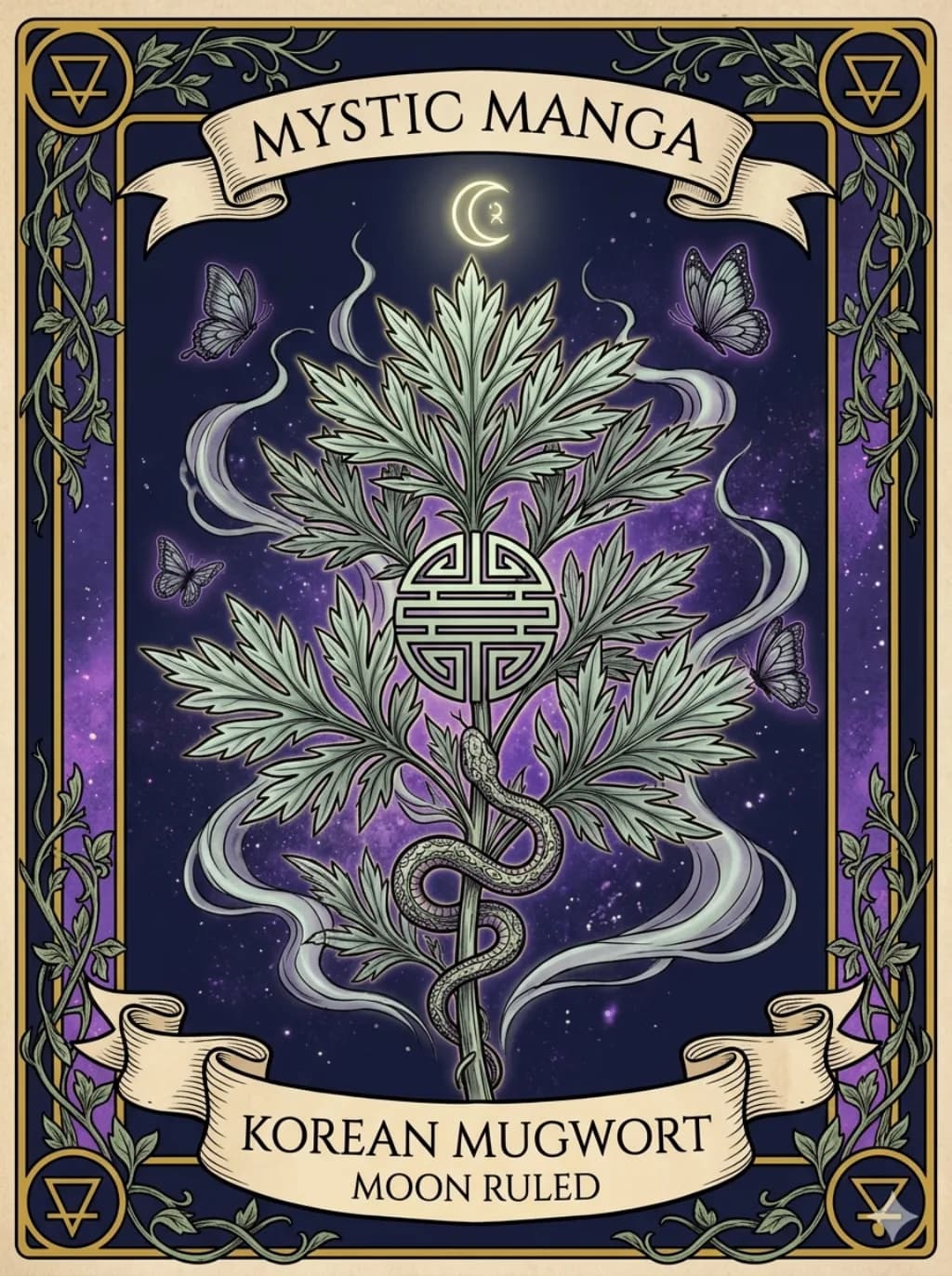
Korean Mugwort (Ssuk)
Artemisia princeps
In short
What are the magical properties of Korean Mugwort (Ssuk)?
Korea's sacred herb. Ssuk is at the foundation of Korea's founding myth.
Description
Korea's sacred herb. Ssuk is at the foundation of Korea's founding myth.
Korean Mugwort, Ssuk (Artemisia princeps), governed by the Moon and the Earth element, holds a uniquely foundational place in Korean spiritual culture. It is literally woven into the nation's origin story. In the Dangun myth, the founding legend of Korea, a bear and a tiger are given garlic and ssuk and told to eat only these foods in a dark cave for one hundred days. Only the bear endures, and it transforms into a woman who becomes the mother of Dangun, the first Korean. This myth encodes ssuk's deepest magical meaning: it is the herb of transformation through patient endurance, of becoming fully human through spiritual discipline. It is also the plant of ancestral connection, threading the practitioner back to the very origin of their lineage. In Korean folk medicine, ssuk baths (ssuk-tang) are used for purification, warming, and longevity: practices that mirror its magical profile precisely. In the kitchen, ssuk flavors rice cakes (tteok) eaten at ceremonial occasions, blending the nourishing and the sacred. Moxibustion with ssuk moxa is a pan-Asian healing art recognizing its deeply penetrating, warming energy. Korean mugwort healing ritual practice is gentle, deep, and ancestrally rooted: a lunar earth herb of remarkable cultural and magical depth.
Magical Properties
Purification, Longevity, Protection, Healing, Ancestral connection.
Rituals
- ✦Prepare a ssuk herbal bath for purification, energetic warming, and connection to ancestral lineage.
- ✦Use ssuk moxa in a moxibustion practice for energetic healing and the activation of life force.
Botanical Data
Correspondences
Related Crystals (Earth)
Related Herbs (Moon)
Explore further
Frequently asked questions
What are the magical properties of Korean Mugwort (Ssuk)?+
Korea's sacred herb. Ssuk is at the foundation of Korea's founding myth. Purification, Longevity, Protection, Healing, Ancestral connection.
Which planet and element rule Korean Mugwort (Ssuk)?+
Korean Mugwort (Ssuk) (Artemisia princeps) is ruled by Moon, associated with the Earth element and the sign Cancer.
How do you use Korean Mugwort (Ssuk) in a ritual?+
Prepare a ssuk herbal bath for purification, energetic warming, and connection to ancestral lineage. Use ssuk moxa in a moxibustion practice for energetic healing and the activation of life force.