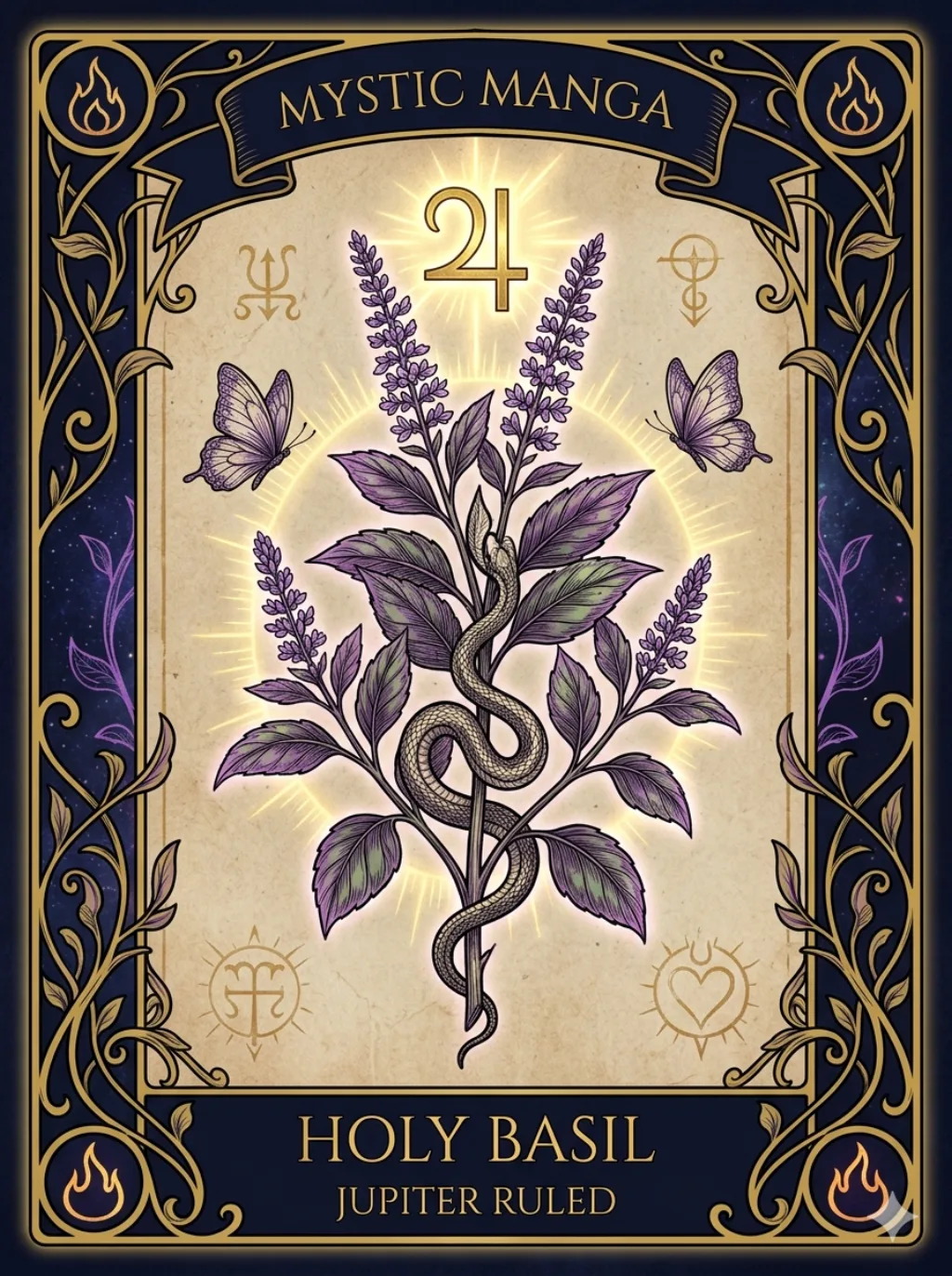
Holy Basil (Tulsi)
Ocimum tenuiflorum
In short
What are the magical properties of Holy Basil (Tulsi)?
The queen of herbs in India. Tulsi is considered the incarnation of goddess Lakshmi.
Description
The queen of herbs in India. Tulsi is considered the incarnation of goddess Lakshmi.
Holy Basil or Tulsi (Ocimum tenuiflorum), sacred to Jupiter and aligned with the Water element in some traditions, occupies a position in Hindu sacred life with no precise parallel in Western magical herbalism: it is not merely an altar herb but a deity in plant form. The Vishnu Purana describes Tulsi as the incarnation of Lakshmi, goddess of abundance and auspiciousness, who descended to earth in the form of this fragrant plant. Virtually every Hindu household maintains a living Tulsi plant in a designated courtyard shrine, the 'Tulsi mandap', which is watered, garlanded, and circumambulated as an act of daily devotion. This practice is simultaneously a spiritual discipline, a household blessing, and a continuous invocation of divine protection and grace. In Ayurveda, Tulsi is classified as a rasayana: a category of adaptogens said to promote longevity, enhance vitality, and increase ojas, the subtle essence of spiritual radiance. Modern clinical research validates its adaptogenic, anti-inflammatory, and immune-modulating properties, supporting centuries of therapeutic use. For practitioners working with devotional magic, abundance rituals, or purification practices with a Hindu or cross-cultural spiritual orientation, Tulsi's purifying and protective properties are extraordinary. Holy Basil magical properties for divine protection, purification, sacred love, and spiritual longevity are foundational to the world's largest living magical tradition.
Magical Properties
Purification, Devotion, Divine protection, Sacred love, Longevity.
Rituals
Botanical Data
Correspondences
Related Crystals (Fire)

Related Herbs (Jupiter)
Explore further
Frequently asked questions
What are the magical properties of Holy Basil (Tulsi)?+
The queen of herbs in India. Tulsi is considered the incarnation of goddess Lakshmi. Purification, Devotion, Divine protection, Sacred love, Longevity.
Which planet and element rule Holy Basil (Tulsi)?+
Holy Basil (Tulsi) (Ocimum tenuiflorum) is ruled by Jupiter, associated with the Fire element and the sign Sagittarius.